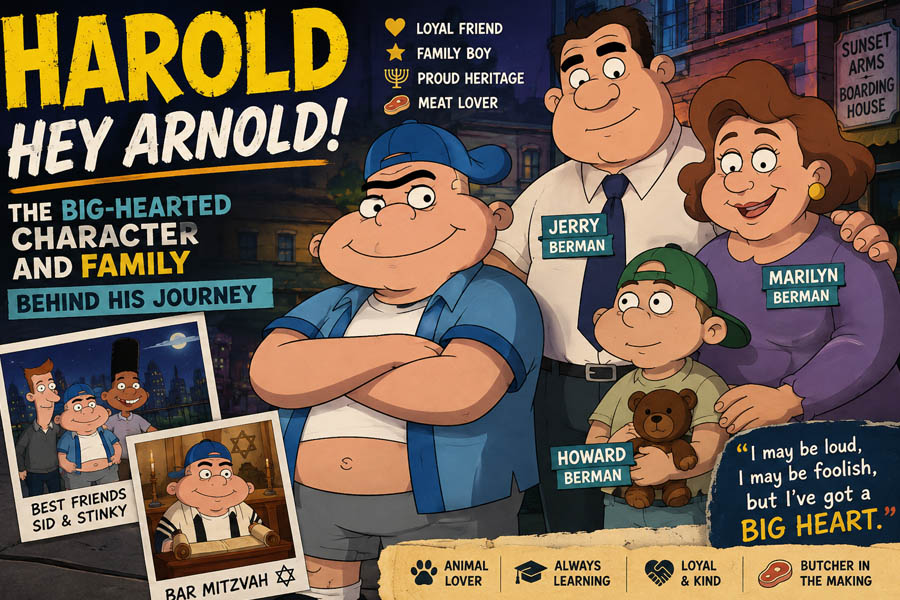
Basic Information
| Detail | Information |
|---|---|
| Full Name | Harold Berman |
| Series | Hey Arnold! |
| Character Type | Fictional supporting character |
| Created By | Craig Bartlett |
| Network | Nickelodeon |
| School | P.S. 118 |
| Approximate Age | 13 during his Bar Mitzvah |
| Grade | Fourth grade |
| Heritage | Eastern European Jewish-American |
| Voice Actor | Justin Shenkarow |
| Father | Jerry Berman |
| Mother | Marilyn Berman |
| Best Friends | Sid and Stinky Peterson |
| Love Interest | Patty Smith |
| Notable Episode | “Harold’s Bar Mitzvah” |
| Occupation | Student; temporary butcher shop apprentice |
| Home | Next door to Arnold’s Sunset Arms neighborhood |
When I think about Harold Berman from Hey Arnold!, I do not see him as simply the loud, overweight kid who occasionally causes trouble. Harold is one of those animated characters who becomes much more interesting the longer you watch him. Beneath the tough talk, teasing, and exaggerated confidence is a boy wrestling with insecurity, fear, friendship, family expectations, and the uncomfortable process of growing up.
Harold is a classmate of Arnold Shortman at P.S. 118. He is short and stocky, recognizable by his distinctive unibrow and loud personality. During the early episodes, he often behaves like a bully, especially when he is with Sid and Stinky. Yet his toughness frequently collapses when something genuinely frightens him. His famous tendency to call for his mother when scared becomes part of the humor, but it also reveals something important about him: Harold wants people to believe he is tougher than he actually feels.
That contradiction becomes the heart of his character.
Harold Berman’s Personality and Appearance
Harold is portrayed as overweight, with a compact build and an expressive face dominated by his large unibrow. His appearance is intentionally exaggerated, matching the colorful visual language of Hey Arnold! while giving him a distinctive silhouette that is easy to recognize.
His personality is equally memorable. Harold can be obnoxious, immature, boastful, anxious, fearful, and impulsive. He frequently tries to establish himself as one of the toughest kids in the neighborhood, only to discover that his confidence is sometimes built on shaky ground.
I find that contrast especially effective because Harold is not simply written as a bully. He is a child performing the role of a bully.
As the series develops, his softer qualities become increasingly visible. Harold can be deeply loyal and surprisingly compassionate. He cares about animals, worries about people he considers friends, and occasionally demonstrates courage when someone needs help. His character gradually shifts from antagonist to companion, particularly as Wolfgang increasingly occupies the role of the bigger neighborhood bully.
Harold’s food obsession is another recurring feature. He has a particular fondness for meat and other food, and this becomes connected to his struggles with weight and body image. Episodes such as “Weighing Harold” give those issues emotional weight rather than treating them purely as jokes.
Harold’s Age and School Life
One of the unusual details about Harold is his age. Although he attends fourth grade with Arnold and the other children, Harold is around 13 years old when he celebrates his Bar Mitzvah.
His being held back in school helps explain why he is older than his classmates.
This creates an interesting layer in the character. Harold is physically and emotionally somewhere between childhood and adolescence, while many of his classmates are younger. He sometimes wants to be treated as a tough older kid, yet he remains frightened of growing up.
His academic struggles are also part of his story. “The Aptitude Test” plays with Harold’s understanding of intelligence when he mistakenly believes he has been identified as a genius. Instead of treating the situation casually, Harold attempts to become the person he thinks the test says he should be.
The episode captures one of Harold’s recurring problems: he often lets other people’s expectations define how he sees himself.
Harold’s Parents: Jerry and Marilyn Berman
Harold’s family helps explain the mixture of toughness and vulnerability that defines him.
Jerry Berman
Jerry Berman is Harold’s father and is voiced by David Wohl. He is characterized by his extremely low voice and relatively calm demeanor.
Jerry appears concerned about Harold’s weight and behavior. His approach can sometimes seem judgmental, particularly when Harold’s appearance becomes a subject of family concern, but he is ultimately part of a family that cares deeply about Harold.
The relationship between father and son contributes to Harold’s insecurities. Harold wants approval, even when he pretends that he does not care what anyone thinks.
Marilyn Berman
Marilyn Berman, voiced by Kath Soucie, is Harold’s mother. She can be more openly emotional and vocal when Harold gets into trouble.
Her frustration is balanced by obvious affection. When Harold runs away or finds himself in a vulnerable situation, Marilyn’s concern becomes unmistakable. She also tries to encourage him socially and emotionally, even when her methods sometimes embarrass him.
Harold’s repeated calls for “Mommy” become a running joke, but they also reveal how much emotional security he associates with his mother.
Harold’s Extended Family
Harold’s wider family is less developed than his parents, but several relatives are referenced within the broader character material.
An unnamed aunt is mentioned in connection with his family, while an uncle is associated with an unusual alligator farm mentioned in “Return of the Sewer King.” Extended references have also circulated concerning a younger brother named Howard Berman, although this element is less prominent in the central television storyline.
These details give Harold a family world beyond the classroom, even though the series generally keeps its attention on his immediate adventures.
Harold and Sid and Stinky
Harold’s closest friendships begin with Sid and Stinky Peterson. The three boys often operate as a small unit, particularly during the earlier part of the series.
Their friendship is sometimes built around mischief, teasing, and attempts to appear tougher than they really are. Harold can be the loudest member of the group, but he is also capable of being pushed around by circumstances.
As the series progresses, the friendship dynamic changes. Harold becomes less focused on bullying and more integrated into Arnold’s broader circle.
His relationships demonstrate that children are not fixed into permanent social roles. The bully can become the friend. The troublemaker can become the person who helps. The loudest kid in the room can also be the most frightened.
Harold and Arnold Shortman
Arnold and Harold do not begin as the closest friends, but their relationship develops considerably.
Arnold often sees through Harold’s aggressive exterior. Rather than simply responding to Harold’s behavior with hostility, Arnold frequently helps him recognize the better qualities already inside him.
Their relationship is particularly important in “Harold’s Bar Mitzvah.” When Harold runs away because he is frightened of becoming an adult, Arnold follows him and tries to bring him home.
Arnold becomes almost like a quiet compass for Harold. He does not magically solve Harold’s problems. Instead, he helps Harold recognize that he is already capable of doing the right thing.
Harold and Patty Smith
Patty Smith, often called “Big Patty,” becomes an important romantic interest for Harold.
Patty has a reputation as one of the toughest girls at school, which makes her an unusual match for Harold. Their relationship develops when they discover that they have more in common than they initially realize.
“Hey Harold!” reveals a gentler side of Harold. Instead of trying to impress Patty purely through bluster, he begins to connect with her on a more personal level.
Their relationship works because Patty does not simply fall for the loud version of Harold. She responds to the more genuine person underneath.
Harold’s Bar Mitzvah
The episode “Harold’s Bar Mitzvah” may define Harold.
Harold, 13, prepares for his Bar Mitzvah. He first loves the gifts and celebration. He is advised by Elliott Gould’s Rabbi Goldberg that the ritual symbolises duty and maturity.
Harold finds growing up overwhelming.
He flees to Elk Island to avoid the milestone. Harold’s excursion becomes an unexpected test of his lessons when Arnold follows him.
He brings Danny back to his mother, showing righteousness. Giving up his Mr. Fudgie popsicle to stop two kids from arguing shows charity. In a bus bully incident, he prays in Hebrew.
Harold doesn’t realise these activities show Rabbi Goldberg’s teachings.
That’s why the story works. By doing, Harold learns.
He returns for the ceremony and reads the Torah. His infantile aspect persists, but he completes his Bar Mitzvah and celebrates.
After Stinky takes his yarmulke and Harold laments for his mother, the show refuses to pretend that one ceremony makes him a grownup. Instead, it shows steady maturity.
Rabbi Goldberg and Harold’s Growth
Rabbi Goldberg serves as an important mentor during Harold’s Bar Mitzvah story.
His role is not merely to teach Harold religious procedures. He encourages Harold to understand responsibility, good deeds, charity, prayer, and the importance of becoming a good person.
For Harold, this is difficult because he initially sees adulthood as a collection of privileges rather than responsibilities.
The episode uses humor to make a serious point. Growing up is not about suddenly becoming fearless or perfectly responsible. It is about making better decisions even when fear is still present.
Harold’s experience gives the Bar Mitzvah storyline emotional depth while also introducing young viewers to Jewish traditions such as Torah reading, Hebrew prayers, the yarmulke, tallit, challah, and the community celebration.
Harold’s Work at Green’s Meats
Harold’s closest connection to a future career comes in “Harold the Butcher.”
After stealing a ham, Harold ends up working at Green’s Meats. What begins as punishment and an opportunity to learn responsibility unexpectedly becomes something he enjoys.
Harold discovers that he has an affinity for meat products and the practical work of a butcher shop.
There is an appealing irony here. Harold’s obsession with food, initially associated with overeating and insecurity, becomes connected to a possible skill. The episode transforms a character flaw into an opportunity for growth.
Harold does not have an adult salary, professional résumé, or personal net worth because he is a fictional child character. His meaningful achievements are instead measured through experiences, relationships, responsibility, and personal growth.
Harold’s Character Development
Across Hey Arnold!, Harold gradually becomes less of a conventional bully and more of a complicated supporting character.
His growth can be seen in several recurring areas:
| Area | Early Harold | Developing Harold |
|---|---|---|
| Friendship | Often antagonistic | More loyal and dependable |
| Confidence | Loud and boastful | More honest about insecurity |
| Fear | Easily frightened | Increasingly capable of facing problems |
| Family | Embarrassed by parental attention | Clearly dependent on their support |
| Body Image | Defensive and insecure | More willing to confront his feelings |
| Responsibility | Avoids consequences | Learns from mistakes |
| Identity | Tries to act tough | Becomes more comfortable with himself |
| Social Life | Bullying and posturing | Greater integration with Arnold’s group |
To me, this is what makes Harold memorable. His transformation is not dramatic in the traditional superhero sense. It happens in small moments.
He learns to apologize. He learns to care. He discovers that courage does not require pretending to be fearless.
Harold’s Cultural Identity
Harold’s Jewish identity is an important part of his characterization, particularly in “Harold’s Bar Mitzvah.”
The series incorporates Jewish traditions into a broader story about adolescence without making Harold’s identity feel like a single defining trait. His Bar Mitzvah is simultaneously a religious ceremony, a family event, a community celebration, and a personal challenge.
His Eastern European Jewish-American background contributes another dimension to the diverse neighborhood portrayed in Hey Arnold!.
The show often uses ordinary childhood experiences to explore larger questions. In Harold’s case, the question is simple but powerful: what does it mean to grow up?
Harold’s Legacy in Hey Arnold!
Harold remains one of Hey Arnold!’s more complex supporting characters. because his talents and shortcomings belong together.
His drama makes him funny. Bravery often covers fear, making him empathetic. He is remarkable because he is not a bully, comic relief, or greatest buddy.
Harold gets energised by Justin Shenkarow’s voice. Harold seems like a child attempting to convince everyone, including himself, that he has everything under control, with his loud voice, abrupt fear, overstated confidence, and emotional fragility.
Harold appears in fan debates, nostalgia videos, character analysis, and Nickelodeon animation discussions years after the original series. His narrative resonates because he struggles with timeless issues like desiring acceptance, feeling insecure about beauty, worrying about education, fearing change, and finding yourself.
Harold may rant, posture, eat, worry, and run away from responsibility throughout his youth. But underneath it is a character learning to be a better friend and person.
FAQ
Who is Harold in Hey Arnold!?
Harold Berman is a fictional supporting character and one of Arnold’s classmates at P.S. 118. He begins as a loud, bully-like child but gradually becomes a more caring and loyal friend.
How old is Harold Berman?
Harold is approximately 13 years old during his Bar Mitzvah. He is unusually old for fourth grade because he has been held back in school.
Who are Harold’s parents?
Harold’s parents are Jerry Berman and Marilyn Berman. Jerry is voiced by David Wohl, while Marilyn is voiced by Kath Soucie.
Who are Harold’s best friends?
Harold’s closest early friends are Sid and Stinky Peterson. As the series develops, he also becomes increasingly friendly with Arnold, Gerald, and other neighborhood children.
Who is Harold’s love interest?
Harold develops a relationship with Patty Smith, also known as Big Patty. Their connection becomes more apparent after they discover shared interests and vulnerabilities.
What happens in Harold’s Bar Mitzvah?
Harold becomes frightened about growing up and runs away before his Bar Mitzvah. During his journey, he unknowingly demonstrates the values he was taught before returning home and successfully completing the ceremony.
Who is Rabbi Goldberg?
Rabbi Goldberg is the rabbi who helps Harold prepare for his Bar Mitzvah. He serves as a mentor who teaches Harold about responsibility, good deeds, charity, prayer, and maturity.
Does Harold have a job?
Harold temporarily works as an apprentice at Green’s Meats in “Harold the Butcher.” The experience reveals that he has a genuine interest in butchery and meat-related work.
Is Harold a bully?
Harold is initially portrayed as a bully, particularly when he is with Sid and Stinky. Over time, however, he becomes less antagonistic and reveals a much more sensitive and compassionate personality.
Why is Harold important to Hey Arnold!?
Harold adds humor and emotional complexity to the series while representing childhood insecurity, body image concerns, peer pressure, family expectations, and the difficult transition toward maturity.