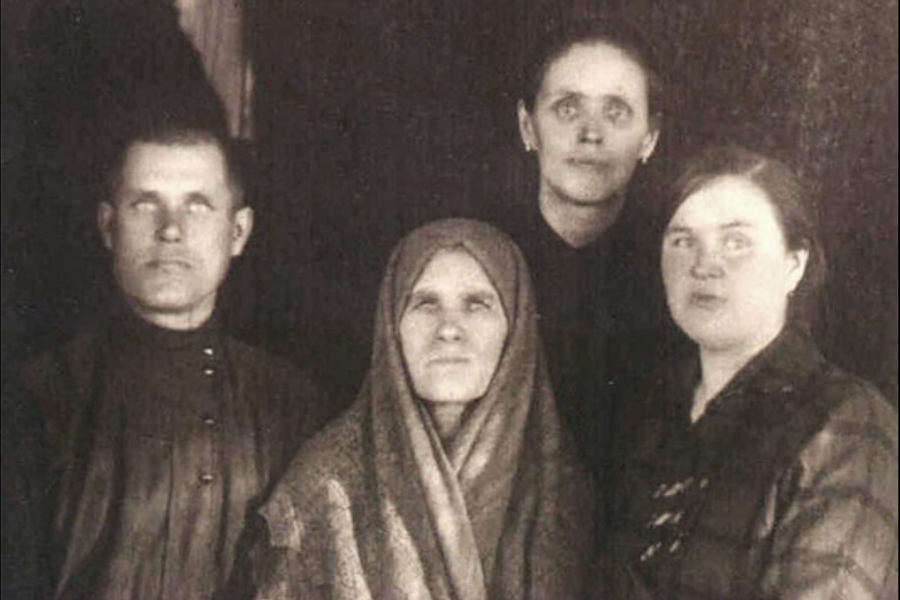
| Basic information | Details |
|---|---|
| Full name | Praskovia Fyodorovna Dubrovina |
| Known for | Wife of Grigori Rasputin and mother of his children |
| Birth | Around 1865 |
| Death | Around 1936 |
| Spouse | Grigori Rasputin |
| Children | Dmitry Rasputin, Maria Rasputin, Varvara Rasputina, and other children who died young |
| Role in history | Family anchor, village wife, mother, and matriarch of a famous line |
A woman at the edge of a storm
Praskovia Dubrovina is a drafty room candle. She did not conquer imperial history like her husband, but she endured. Work, faith, family, and patience defined her Russian peasant life. She is most typically associated with Grigori Rasputin, but her life is more complex.
Praskovia was born around 1865 in rural Russia, when soil and survival took precedence. She started as a modest young woman before becoming inseparable from the Rasputin family. Her 1887 husband was Grigori Rasputin. She married one of Russia’s most controversial personalities, but nobody of them knew how far his fame would spread.
She focused on household life while he pursued religious glory, travel, and royal intrigue. Her story’s intensity comes from contrast. He caused public outrage. The wind passed through her house, but it stood.
Marriage, home, and the private life of history
Praskovia and Grigori Rasputin built a family in the old peasant rhythm of births, losses, and survival. Their home life was not glamorous. It was rooted in village life, where raising children, keeping a household, and enduring hardship were daily acts of will. In that sense, her life was not quiet because it was empty. It was quiet because it was full of work that history often forgets to name.
The marriage appears to have lasted until Grigori’s murder in 1916. During the years before that, he was frequently away, and his reputation grew far beyond the village. Praskovia remained closer to the family center. That matters. In a family story dominated by a famous husband, the person who holds the interior space often becomes invisible. Yet without that interior, the whole structure collapses.
I see her as a keeper of continuity. Grigori Rasputin moved through public life like a moving flame, bright and dangerous. Praskovia stayed with the hearth. She did not become a celebrity. She became the still point around which children were raised and family memory survived.
The children of Praskovia Dubrovina
The Rasputin household had seven children in total, but only three are commonly identified as surviving to adulthood. That pattern, sadly, was not unusual in the era. Child mortality shaped family life across Russia, and Praskovia’s story carries that sorrow in its bones.
Dmitry Rasputin was one of the surviving children. He is less widely known than his sister Maria, but he remains part of the family line and the documented Rasputin story. His life is one of those shadowed biographies that history keeps at the edge of the frame.
Maria Rasputin became the most famous of Praskovia’s children. She was born in 1898 and later wrote about her father, making the family story travel far beyond the village. Through her, Praskovia’s name entered memoirs, family histories, and later retellings. Maria carried the family memory into a wider world, and that made her a living bridge between private life and public history.
Varvara Rasputina, born around 1900, is the third surviving child most often named in the record. Like her brother Dmitry, she is less documented than Maria, but she remains part of the line that connects Praskovia to later generations.
The children who died young are harder to trace by name, and that uncertainty is itself a historical fact. It reminds me that peasant family records were often incomplete, fragile, and uneven. What survives is not always the whole story. Sometimes it is only the outline of a grief that never got written down properly.
Grigori Rasputin as husband and public figure
To understand Praskovia Dubrovina, I have to place Grigori Rasputin in the center of the wider historical stage. He became a mystical and political figure in the final years of the Russian Empire, moving close to the imperial court and gaining extraordinary notoriety. That public life made him famous, feared, mocked, and mythologized.
For Praskovia, however, he was first a husband and father. This matters because history often distorts people by rank. A man becomes an icon, and the woman beside him becomes a footnote. I do not think Praskovia was a footnote. I think she was the foundation under the plank floor, unseen but carrying the weight.
Their marriage connected her to a family legacy that later stretched across Russia, Europe, and North America through descendants and memoirists. Grigori’s death in 1916 marked the end of one era and the beginning of another. After that, the family story became one of memory, migration, and inheritance.
Later generations and family continuation
When I trace my family, Praskovia becomes more important. Her daughter Maria Rasputin is a public storyteller, and her descendants include Tatyana Soloviev and Maria Solovieff. The descendants continued the family story into the 20th century.
Tatyana Soloviev, the granddaughter who inherited story and bloodline, represents the next layer of memory. Another granddaughter, Maria Solovieff, continues the line. The family then includes great-grandchildren Laurence Huot-Solovieff and Serge Boissevain. Praskovia becomes a root system by descent. Although far apart, branches feed from the same subterranean source.
That fascinates me most. Praskovia never became famous. She left few modern offices, titles, or accomplishments. Her family became historical. Her marriage, delivery, survival, and memory shaped a lineage historians now track.
What I can say about her work and standing
There is no reliable record of Praskovia Dubrovina holding a formal career or public office. Her work was domestic, practical, and relentless. She likely managed the rhythms of village life, raised children, kept a household, and endured the disruption that came with her husband’s fame. That kind of labor rarely gets framed as achievement, but I think that is a mistake.
A household can be a fortress. A mother can be the archive. A wife can be the keeper of continuity when a family is being pulled in two directions, one toward the village and one toward history. Praskovia’s life seems to have been exactly that kind of labor. Her achievements were not ceremonial. They were human. They were measured in survival, memory, and the fact that a family remained legible after generations of upheaval.
FAQ
Who was Praskovia Dubrovina?
Praskovia Dubrovina was the wife of Grigori Rasputin and the mother of his children. She was born around 1865 and died around 1936. Her life is remembered mainly through her family ties and her place in the Rasputin lineage.
How many children did she have?
She had seven children in total, though only three are commonly described as surviving to adulthood. Those surviving children were Dmitry Rasputin, Maria Rasputin, and Varvara Rasputina.
Was Praskovia Dubrovina a public figure?
Not in the usual sense. She was not known for a public career or political role. Her historical importance comes from her marriage, her children, and her position as the family matriarch.
What is known about her work?
The record does not show a formal profession or business career. Her work was domestic and family centered, shaped by village life, child raising, and household management.
Why is she remembered today?
She is remembered because she was the wife of Grigori Rasputin and the mother of the children who carried the family line forward. Her descendants and family history keep her name alive, even though her own voice is much quieter than her husband’s legend.